
It all continued with a deeper dive and a second cup of coffee.
Introduction
Ambulatory surgery centers (ASCs) have become a central component of the outpatient healthcare delivery system in the United States. These facilities provide surgical procedures that do not require inpatient hospitalization and typically discharge patients within 24 hours. Under federal definitions, ASCs are distinct entities that operate solely for outpatient surgical services, while hospital outpatient departments (HOPDs) represent surgical services owned and operated by hospitals as part of their licensed facilities. (CMS.gov)
Although both environments deliver similar types of outpatient surgical procedures, their organizational structure, regulatory environment, financial incentives, and facility design requirements differ significantly. These differences directly influence building layout, space programming, operational workflows, and risk management. Understanding these distinctions is essential for healthcare planners, architects, and health system leaders when evaluating ambulatory surgery strategies.
Cost Structure and Economic Drivers
One of the most significant distinctions between HOPDs and physician ASCs lies in cost and reimbursement.
Studies have shown that procedures performed in ASCs often cost substantially less than those performed in hospital outpatient departments, sometimes as little as 53% of the HOPD payment rate for similar procedures. (AAOS)
These cost differences arise from:
- Lower overhead expenses
- Leaner staffing models
- More focused case mixes
- Faster patient throughput
As a result, both payers and policymakers increasingly encourage the migration of appropriate procedures to ASCs to reduce overall healthcare spending.
Risk and Liability Considerations
Although both environments operate under rigorous safety regulations, their risk profiles differ.
Hospital-Based ASC Risk Profile
Advantages include:
- Immediate access to hospital resources
- Ability to escalate care quickly
- Greater clinical support infrastructure
However, hospital-based settings also carry risks such as:
- Higher operational costs
- Increased administrative complexity
- Exposure to hospital regulatory frameworks
Physician-Based ASC Risk Profile
Physician ASCs often offer advantages including:
- Lower infection rates due to smaller patient volumes
- Highly specialized surgical teams
- Greater procedural efficiency
However, risks include:
- Limited capacity to manage major complications
- Dependence on transfer agreements with hospitals
- Greater financial exposure for physician owners
Risk management strategies typically include strict patient selection criteria, emergency transfer protocols, and robust anesthesia screening processes.
Both models are governed in each state by the local AHJ’s and industry standards as is often aligned by FGI to mitigate risk liabilities, however FGI is the minimum baseline and does not factor operational risks (subjective) over programmatical risks (objective), and this is apparent both in the program service-line ratios (affected by risk) and the program infrastructure (objective).
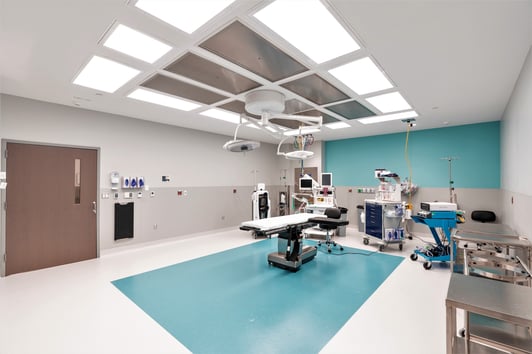
HOPD/H-ASC surgical platforms generally provide:
- Larger operating rooms to accommodate a broader range of procedures
- Expanded recovery areas, including Phase I and Phase II PACU zones
- More robust sterile processing facilities
- Greater equipment storage
- Additional support spaces for anesthesia and imaging
These programs are designed to handle greater patient acuity and variability.
Typical planning ratios often include:
- 3–4 pre-op bays per operating room
- 2–3 PACU spaces per OR
- Larger and localized sterile processing departments (or shared with the hospital)
Physician-owned facilities typically emphasize high efficiency and standardization with a narrower focus on a specific service modality. Many of current ASCs are joint ventures between the physicians with ASC operating companies that include hospital partners.
Design characteristics often include:
- Right-sized operating rooms focused on a specific specialty
- Reduced PACU footprints
- Streamlined sterile processing procedures (often outsourced), limited to narrower scope
- Minimal redundant support spaces
The design philosophy prioritizes throughput and rapid patient turnover, resulting in more compact floor plates and smaller overall square footage. However, as more ASC partnerships are emerging, they are developing multi-modal service lines with OR footprints designed to be flexible as technology is changing the types of procedures they can do in an ambulatory setting with hybrid and robotics.
Hospital-Based ASC Infrastructure often leverage the hospital’s shared systems:
- Central sterile processing
- Medical gas infrastructure
- Emergency response systems
- Imaging and laboratory services
- Backup power and redundancy
Because they are integrated with the hospital campus, these facilities can rely on nearby inpatient services if complications arise.
Physician-Based ASC Infrastructure operate as self-contained environments, meaning that must exist within the facility itself. These systems often include:
- Dedicated HVAC systems
- Isolated power systems & Designated EES’s with generators
- On-site sterilization equipment
- Medical gas distribution
- Emergency resuscitation capability
Conclusion
Understanding the key differences between HOPDs and physician-based ASCs is vital for healthcare professionals involved in planning and operational strategy. Each model has unique advantages and challenges that impact patient care, operational efficiency, and risk management.